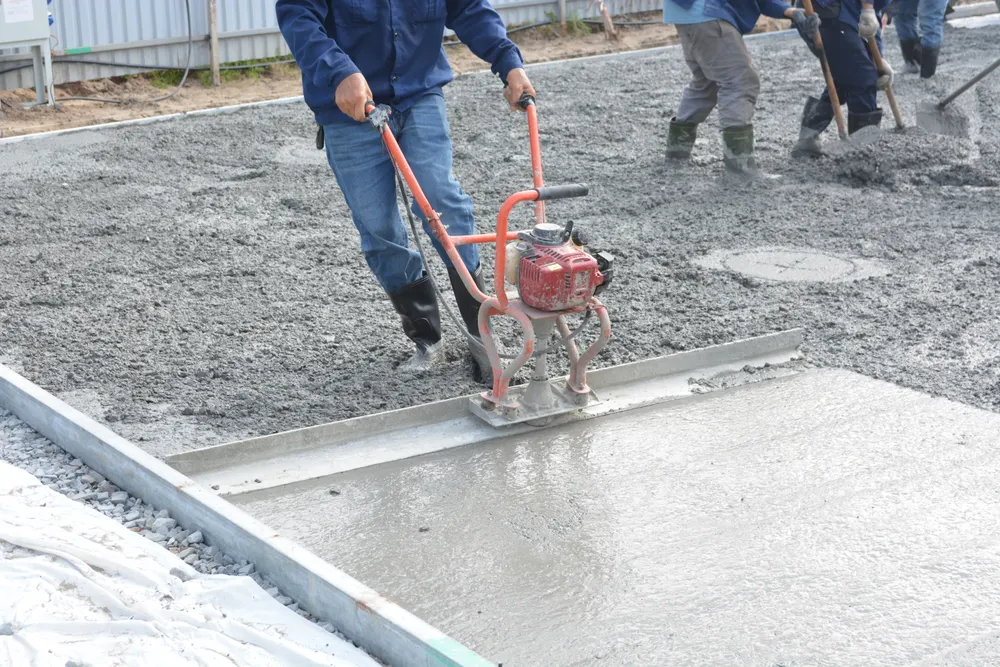
Concrete & Paving South Fort Worth has spent 15 years coordinating concrete crews for the driveways, patios, slabs, and commercial flatwork of Forest Hill, Benbrook, Crowley, and the wider Fort Worth metro. We're open 24 hours a day, and every pour is scoped in writing before a crew is booked — not as a slogan, but because Tarrant County's expansive clay doesn't wait for business hours to start moving. What follows is the plain version of who we are, and why fifteen years of coordinating pours on this specific ground matters more than it sounds. If you're comparing options, our reviews page has the honest version of how that coordination has actually gone.
Who We Are
We're a concrete coordinator, not a single crew with one mixer truck. Concrete & Paving South Fort Worth manages the scheduling, scoping, and quality standards for driveway, patio, slab, and commercial concrete projects, and matches each one with a crew set up for that specific scope — a small finishing crew for a residential walkway, a full pour-and-place operation with pump trucks for a commercial parking lot. That structure lets us staff jobs during the busy spring and fall pouring season without a homeowner or property manager waiting weeks for a single small crew to free up. You still get one point of contact, one written estimate, and one number — (817) 207-5313 — to call about anything that comes up, whether that's a new driveway from our services list or a slab repair.
Fifteen Years Coordinating Concrete Crews Across South Fort Worth
Fifteen years in Forest Hill, Benbrook, and Crowley means we've watched the same driveways and slabs move through the same wet-dry cycle for a decade and a half. Base compaction, rebar sizing and joint spacing are committed in writing on every job, and workmanship is guaranteed in writing rather than promised over the phone. That matters most on the jobs where a mistake is expensive to fix later — a commercial slab poured without adequate rebar, or a driveway base that wasn't compacted to spec before a single yard of ready-mix arrived. Call and we'll confirm exactly what the written scope covers on your specific job before any crew is scheduled or any contact form gets a callback.
Why Local Knowledge of Expansive Clay Matters
South Fort Worth sits on some of the most expansive soil in the country — high-plasticity "black gumbo" clay weathered from the Cretaceous Eagle Ford and Woodbine formations, with clay content across Tarrant County frequently exceeding 50%. That clay swells wet and shrinks hard through the long Texas summer, moving several inches seasonally along corridors like the South Freeway, US-287, Loop 820, and the Chisholm Trail Parkway, heaving, cracking, and settling anything poured on top of it without the right prep. Concrete is the second most-consumed material on Earth after water, which is exactly why the base prep, compaction, rebar placement, and control-joint spacing decided before a single truck arrives matter so much — those choices determine whether a slab handles that movement or fights it for fifteen years. The crews we coordinate with pour to ACI 318, ACI 332, and ACI 330 depending on the job, and they follow ASTM C94 specifications for every ready-mix delivery rather than a one-size-fits-all approach. They also build every schedule around the "70-in-7, full-at-28" cure timeline — roughly 70% strength at 7 days, full design strength at 28 — with light foot traffic cleared in 24-48 hours and heavy loads held off until the full month has passed, because rushing that window is one of the most preventable causes of early cracking on South Fort Worth's shifting ground.
The Coordinator Model, Explained Honestly
We coordinate rather than employ a single fixed crew, and we'd rather explain that plainly than let a vaguer page imply something it isn't. When you call, we scope the job, put together a written estimate, and schedule a concrete crew equipped for your specific project — whether that's a new driveway, a stamped patio, a full commercial slab, or a control-joint repair. That's a different model from a single small outfit trying to be everything to every customer, and it's why we can generally move faster during peak pouring season than a shop with one crew and one mixer. If you're comparing us against another South Fort Worth concrete company, ask them the same question we're answering here — who's actually doing the pour, and what the written scope commits them to.
If you're ready to talk through a project, the same South Fort Worth concrete contractor that's answered calls for fifteen years is one phone call away — (817) 207-5313, any hour, any day. Visit how to reach us for what to have ready before you call and how the free written estimate process works.
Frequently Asked Questions
How long has Concrete & Paving South Fort Worth been coordinating concrete crews in the area?
Concrete & Paving South Fort Worth has spent 15 years coordinating driveway, patio, slab, and repair projects across Forest Hill, Benbrook, Crowley, and the wider Fort Worth metro. In that time the underlying ground problem hasn't changed — Tarrant County's expansive black gumbo clay still heaves and settles anything poured on top of it — but knowing exactly how a specific south-side street or lot moves through a wet-dry cycle comes from fifteen years of working this ground, not a generic national playbook. We're open 24 hours a day for calls, and the base, rebar and joint plan are fixed in writing before ready-mix is ordered. Fifteen years in one metro means we've usually already seen the crack pattern before it shows up at your address.
How do you keep a slab from cracking on black gumbo clay?
You don't stop black gumbo clay from moving — you build the slab so the movement doesn't destroy it. That starts with excavating to a consistent depth and compacting a gravel base, because clay that swells unevenly under an uncompacted slab is what tilts and cracks it first. Reinforcement is next: rebar or welded-wire mesh sized for the load and set on chairs at mid-depth, not laid on the ground where it does nothing. Then the joints — cut early, to a quarter of the slab depth, and spaced so the concrete has somewhere planned to crack instead of choosing its own line across your driveway. That sequence matters most on larger pours, like a commercial parking lot or a retaining wall, where a mistake in base prep or rebar placement costs far more to fix later than it would have cost to get right on day one. Call (817) 207-5313 and we'll walk you through which crew is scheduled and what the written scope covers.
What does 'coordinator' mean — do you have your own concrete crew?
'Coordinator' means exactly what it says: Concrete & Paving South Fort Worth manages the scheduling, scoping, and quality standards for a project, while the actual forming, pouring, and finishing work is carried out by the concrete crews we coordinate with. We're not going to claim 'our trucks' or 'our finishers' when the honest answer is that we match each job — a residential driveway, a stamped patio, a commercial slab — with a crew that's set up for that specific scope and equipment need. That model lets us pull from a deeper bench than a single small crew could staff on its own, especially during the busy spring and fall pouring season. You still get one point of contact, one written estimate, and one number to call if anything needs a follow-up.
Why is South Fort Worth's clay soil such a problem for driveways and slabs?
South Fort Worth sits on some of the most expansive clay in the country — high-plasticity 'black gumbo' soil weathered from the Cretaceous Eagle Ford and Woodbine formations, with clay content across Tarrant County frequently exceeding 50%. That clay swells wet and shrinks hard through the long Texas summer, moving several inches seasonally and heaving, cracking, and settling anything poured on top of it, from a Forest Hill driveway to a Benbrook commercial slab. A crew that skips proper base prep, compaction, or control-joint spacing is setting a slab up to crack or heave within a couple of seasons. Fifteen years of watching how specific south-side lots move through that cycle is exactly the local knowledge a coordinator brings to matching a job with the right crew.
What is the '70-in-7, full-at-28' cure timeline, and why does it matter?
Most concrete mixes reach roughly 70% of their specified compressive strength after 7 days and full design strength at 28 days — a rule of thumb every crew we coordinate builds a schedule around. Light foot traffic is generally fine after 24-48 hours, light passenger vehicles after about 7 days, but heavy loads, RVs, and anything crossing a freeze-thaw cycle should wait the full 28 days before use. Cure slows markedly below 50°F, which matters on the occasional South Fort Worth cold snap and is why timing a pour to the weather window is part of scoping the job. Rushing that timeline is one of the most common reasons a new driveway or slab cracks early, and it's entirely avoidable with the right schedule.
What standards do the concrete crews you coordinate follow?
The concrete crews we coordinate with pour to ACI 318 for structural work and ACI 332 for residential slabs and foundations, with ACI 330 governing larger parking-lot pours, and they follow ASTM C94 specifications for ready-mix delivery. That includes correct control-joint spacing to manage the cracking that Tarrant County's clay movement makes almost inevitable without it, proper rebar or welded-wire-mesh reinforcement, and air entrainment where freeze-thaw exposure calls for it. None of that is exotic — it's the difference between a slab built to spec and one that looks fine on pour day but fails within a couple of years. We track which standards apply to a given job, whether it's a driveway or a commercial lot, before a crew ever shows up.
Do you handle both residential concrete work and commercial slabs?
Yes — we coordinate both residential driveways, patios, and walkways and commercial flatwork, slabs, and parking lots across the South Fort Worth metro, and the underlying ground problem is the same for both: expansive clay that moves with the seasons. A homeowner's cracked driveway and a retail center's settling slab differ in scale and load, but the crews we coordinate with bring the right equipment and crew size to each — a smaller finishing crew for a home, a larger pour-and-place operation with pump trucks for a commercial job. Property managers and business owners get the same written estimate and single point of contact that a homeowner does. Whichever side of that split your project falls on, the coordination process starts the same way: a call and a site look.
What areas does Concrete & Paving South Fort Worth serve?
We coordinate concrete projects across Forest Hill, Benbrook, Crowley, Everman, and the broader Fort Worth metro, with our base at 5200 South Fwy, Suite 102 in Fort Worth. That coverage area sits on the same expansive clay belt that runs through the South Freeway (I-35W), US-287, Loop 820, and Chisholm Trail Parkway corridors, so the driveway and slab issues we see in one suburb tend to show up in the next one over on a similar timeline. If you're outside that immediate footprint but still in Tarrant County or the DFW Metroplex, call and we'll confirm whether a job fits into a crew's schedule. Lot size and scope matter more than distance from our base when it comes to matching the right crew to a job.
Why choose a local coordinator over a national concrete franchise?
A national concrete franchise routes your job to whichever subcontractor is available that week, usually without any specific knowledge of Tarrant County's expansive clay or how far south-side soil moves between a wet spring and a dry August. We already know the ground shifts several inches seasonally under Forest Hill, Benbrook, and Crowley slabs, and we build that into how a job gets scoped before a crew ever shows up with a mixer truck. That local knowledge means less time re-diagnosing a problem a generic dispatcher would miss and more time spent getting base prep and control-joint layout right the first time. Fifteen years coordinating pours on this specific ground is the difference between a company that's local in name and one that's actually local in practice.
Why does concrete matter so much for South Fort Worth properties?
Concrete is the second most-consumed material on Earth after water, and it's the material underneath nearly everything that keeps a South Fort Worth property functioning — the driveway, the patio, the foundation slab, the commercial parking lot. Because it's poured as a liquid and then has to cure in place over weeks, how well the base is prepped, how the rebar is placed, and how the mix is finished on day one determines whether it lasts fifteen years or cracks within three. That's a different set of decisions than a material that just gets installed and walked away from, and it's why the crews we coordinate with treat the pour as the start of a 28-day process, not the end of the job. Getting that process right the first time is cheaper than any repair down the line.
What hours can I reach Concrete & Paving South Fort Worth?
Concrete & Paving South Fort Worth is open 24 hours a day, every day, so a call about a cracked driveway, a settling slab, or an active drainage problem gets picked up whenever it comes in rather than routed to voicemail until Monday. Call (817) 207-5313 and we'll talk through the scope, the timeline, and which concrete crew fits the job best. There's no bad hour to call if a slab is actively failing — a heaving driveway or a spalling commercial lot doesn't wait for business hours to get worse. The same coordinator who answers at 2 a.m. answers at 2 p.m.